Monday, November 16, 2026
Home Blog Page 9

Facebook founder Mark Zuckerberg taps UFC President Dana White to join the board of directors

0

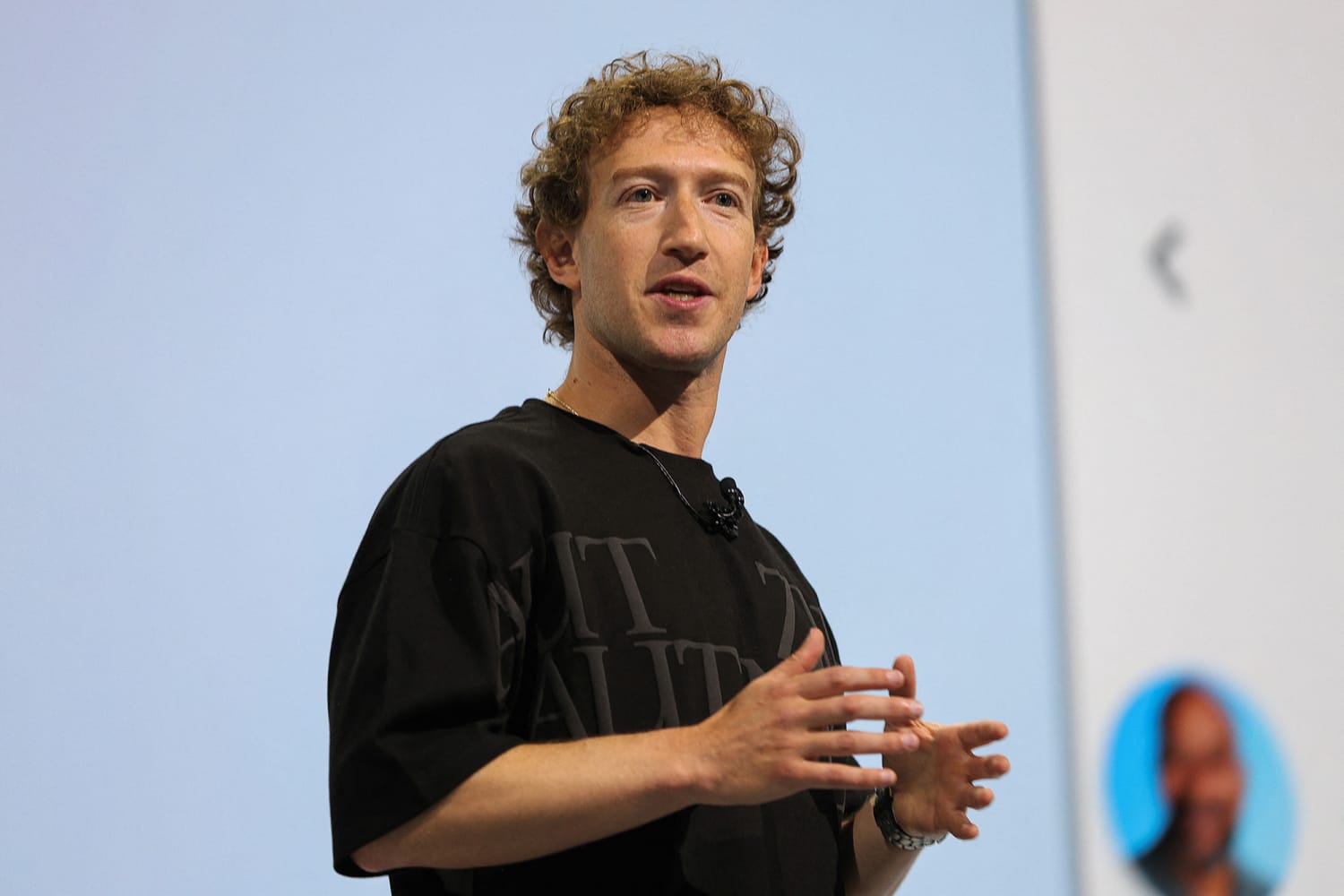
Meta founder and CEO Mark Zuckerberg announced that UFC President Dana White will be joining his company’s board of directors, bringing on the prominent Donald Trump backer less than two weeks before the president-elect is set to take office.

Zuckerberg announced in a Facebook post, saying he admired White “as an entrepreneur and his ability to build such a beloved brand” and that Meta’s new board will help the company capitalize on “massive opportunities ahead in AI, wearables, and the future of social media.”

White, the CEO and president of the UFC, has helped build the popular mixed martial arts promotion to a billion-dollar business and has been in closer proximity with Zuckerberg in the last few years as the billionaire tech chief has taken a public interest in martial arts and attended several UFC events.

White, who endorsed all three of Trump’s runs for president, will join the Meta board not long before the president-elect takes office on Jan. 20 (Trump has attended multiple UFC events and most recently made an appearance at UFC 309 alongside some of his cabinet picks).

Meta also announced John Elkann, CEO of investment company Exor, and former Microsoft executive and tech investor Charlie Songhurst as new additions to the board alongside White.

Zuckerberg and White appear to have grown closer since Zuckerberg began attending UFC events around 2022, becoming more involved in each other’s respective businesses. That year, Meta announced a partnership with the UFC that brought UFC’s streaming video service to Meta Horizon Worlds, a virtual reality platform.

Zuckerberg also had meetings last year with White about the use of artificial intelligence on UFC fighter rankings, according to an interview White had with TNT Sports. White said he was “totally going to fix the rankings” and that the UFC is “going to make a lot of strong moves here coming into 2025.”

Revenge quitting: How could it affect your company in 2025?

0

Experts say workers who feel particularly burned out or frustrated may be more likely to quit with little regard for their employer. There was the Great Resignation. Then, as the pandemic abated and the labour market cooled, came the rise of quiet quitting and the Big Stay, when workers became more reluctant to leave their jobs.

However, employees have been reeling from the Great Betrayal, ushered in by layoffs and quiet firings, coupled with stringent return-to-office mandates and the threat of artificial intelligence. Because employees have either lost their jobs or left of their own volition in response to return-to-office policies, morale has taken a hit at workplaces across the country.

Fastcompany.com reported that perhaps it’s not surprising that the latest workforce trend—and buzzword—is something observers are calling “revenge quitting.” This isn’t an entirely new phenomenon, since it seems to be rooted in workers feeling a sense of detachment from their jobs. The idea behind revenge quitting is that workers who feel particularly burned out or frustrated may be more likely to quit with little regard for whether they leave on good terms with their employer.

In many ways, this is a natural extension of “resenteeism” and “loud quitting,” which have been brewing since 2023. After employees have spent months—or even years—stuck in a job that brings them little satisfaction, it’s not hard to imagine they might eventually snap. This already became evident during the pandemic, when retail employees and other essential workers quit in high numbers after COVID-era changes—like enforcing mask mandates—made their jobs even more difficult.

Experts have suggested revenge quitting is likely to become a common occurrence next year: In a recent report on workplace trends for 2025, Glassdoor noted “a wave of revenge quitting is on the horizon.” But it’s not clear what shape that might take.

Growing resentment could lead more workers to quit their jobs, but it’s also possible many will take care not to burn bridges amid a challenging job market. There are times when it can be important to speak up and call out bad behaviour, even if it compromises your relationship with an employer or manager.

Part 2: Baba Obasanjo and the NNPCL Refineries

0

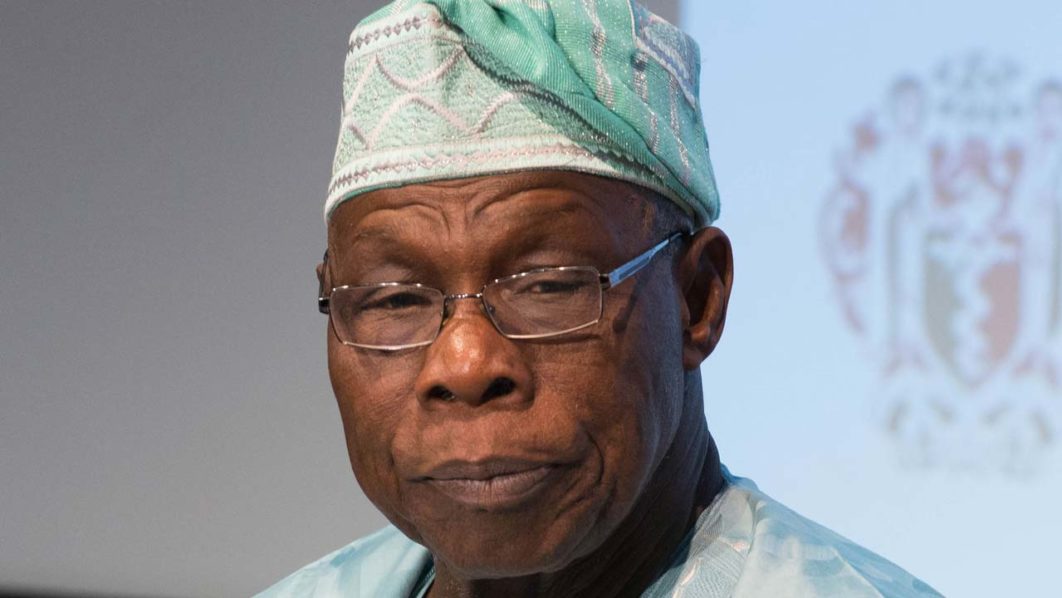
So, while the reversal of the sale is often cited, these days, as a major setback, not everyone agrees with that. Not everyone saw the decision to sell the refineries as the right one. In his interviews with the media on the subject, Baba Obasanjo usually anchors his argument that the refineries can never work on the conversation he said he heard with top Shell executives whom he had invited to take a stake in the refinery and manage it. Shell, he says, gave 4 reasons for declining his offer. According to Baba, the Shell Executive said: ” First of all, they make a major profit from upstream, not from downstream. He said they run downstream just to keep their head above water.

“Two, our refineries were too small: 60,000 barrels 100,000 barrels and I think 120,000 barrels. He said that at that time, the average refinery was going for 250,000 barrels. Three, he said our refineries were not well maintained. Fourth, he said that there was too much corruption around the activities of our refineries and they would not want to get involved in that.”

But looking at these reasons said to have been given by Shell, none of them is novel or suggestive that Shell saw the refineries as beyond redemption, as Baba Obasanjo concluded. Indeed, it is well known that the refinery business is not the most profitable and that upstream is more profitable than downstream. It is easy to understand why Shell, which is not even a player in the Nigerian downstream sector, will not be interested in running a refinery, even with corruption out of consideration. Ironically, observations made by Shell will make such a lasting impression on Baba Obasanjo that he will shut out any suggestion that does not endorse the impression he formed.

It is instructive that following years of fits and starts under different administrations, with efforts at ‘turnaround maintenance’ not yielding lasting results, President Muhammadu Buhari who had worked with President Obasanjo in the past, will then take the bold step of shutting down the refineries and commissioned a complete rehabilitation of the 4 Refineries, as different from the TAMs, in 2021.

At the time, the NNPCL CEO, Mele Kyari said: “I have said it over and over that we have not taken care of these refineries over the years, that we have mismanaged the turnaround maintenance work over time in the last 20+ years, these plants have degenerated to a level that today, we are not turning around but resuscitating them, which is different from TAM.”

Many didn’t understand the difference then, even as many still don’t understand it now, thus going off tangent in their expectations of what the refineries can deliver. At the time the contract for rehabilitation was awarded, some people had also made the point that a new refinery could have been built instead of rehabilitating the old ones, but Mele Kyari explained then:

“We have people saying why not build a new one; why will you repair an old refinery with $1.5 billion? The fact is available even by Google search, what it takes to build a refinery of this status today.”

“It will be difficult for the country to build a new refinery, as it will take four years for it to commence production. It is around $7 billion and $12 billion to construct a refinery of this nature (Port Harcourt refinery),” Kyari argued. Atedo Peterside submitted then that NNPC would only “enmesh Nigeria into a deeper financial mess by throwing $1.5 billion at a problem it created,”, while Prof Pat Utomi argued that “The decision of Federal government to invest $1.5 billion in the repair of Port Harcourt refinery is unwise, unreasonable and has no basis.”

Indeed, only a few gave the NNPCL a chance with the rehabilitation of the refineries, with trust further eroded by multiple failures to deliver to its schedule. But things have turned around in the last 2 months with the commencement of production in the old wing of the Port Harcourt Refinery, and last week’s resumption of production at the Warri Refinery, with indications that the Kaduna Refinery would be going on stream soon. The club of cynics and sceptics is fast thinning out.

Baba Obasanjo appears unconvinced though. “I was told not too long ago that since that time, more than two billion dollars have been squandered on the refineries and they still will not work. If a company like Shell tells me what they told me, I will believe them. But here we are, over $2 billion squandered, and the refineries still won’t work,” Baba Obasanjo declares.

It might be that Baba is of the mind that the rehabilitation work that was done at the refineries is of the standard that was presented to him as having been done in the past, not realising that this is clearly beyond that, with experts positing that what we have now is virtually a new plant.

NNPCL has responded appropriately with its Chief Corporate Communications Officer, Olufemi Soneye, extending an invitation to the former President for a tour of the newly completed refineries to witness first-hand the state of operations there. President Olusegun Obasanjo has a reputation for being forthright and candid. One expects him to honour this invitation and share with Nigerians his impression thereafter. That is the right and honourable thing to do. #

Simbo Olorunfemi works for Hoofbeatdotcom, a Nigerian communications consultancy and publisher of Africa Enterprise. Email: Editor@enterpriseafrica.ng
Baba Obasanjo and the NNPCL Refineries

0

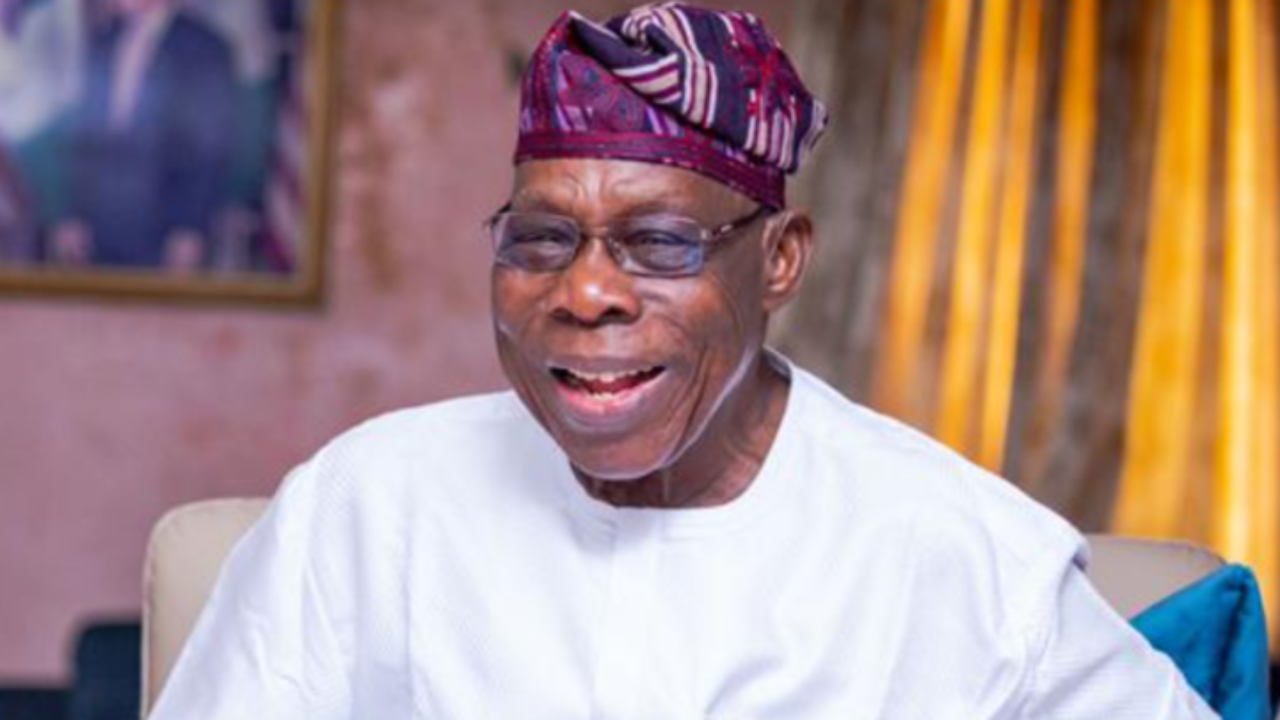
That Baba Obasanjo has an almost child-like emotional attachment to the public-owned refineries under the trust and care of the NNPCL is not in doubt. It is also not difficult to explain why that appears to be the case. He can indeed assert some level of claim/credit for the construction of two of Nigeria’s publicly owned four refineries.

While the decision to construct the second and third refineries in Warri and Kaduna respectively was taken in 1974, with construction on the third set to only commence “whenever the projection of the consumption of petroleum products justifies it”, by early 1975, fuel shortages made it necessary to proceed with its construction soon after.

The Warri Refinery, whose contract was awarded in 1975 before General Obasanjo became Head of State, was completed and commissioned in 1978 while he was in office. The contract for the construction of the Kaduna Refinery was awarded in 1977 and commissioned in 1980.

One interesting fact is that the construction of these Refineries was under the direct supervision of Muhammadu Buhari who was appointed Federal Commissioner (Minister) for Petroleum and Natural Resources in March 1976 and Chairman of the Nigerian National Petroleum Corporation when it was created in 1977, a position he held until 1978.

So, it must have been heart-breaking for Baba Obasanjo to meet the Refineries in a state of much disrepair when he returned as President in 1999. Such was the state of the refineries that even with so much money expended on ‘Turn-around maintenance’ of the refineries while he was in office, there was no turn-around in fortune for the refineries that he had to put them up for sale a few weeks to the end of his administration.

For the Port Harcourt Refinery, Blue Star, a consortium of Nigerian companies Zenon Oil, Dangote Oil, and Gas & Transnational Corp. outbid UK-based Indian steel baron, Lakshmi Mittal, who had offered $550 million. The Dangote-led Blue Star made up of Baba Obasanjo’s associates, paid $561 million to acquire 51% of the government-owned stake in the refinery. There were two other bidders – Oando Plc as well as Sahara Energy in conjunction with Refinee PetroPlus, but the two were disqualified in a process conducted by the BPE. Bluestar will follow up with the buy-in in Port Harcourt to, soon after, also take a 51% stake in the Kaduna Refining Company.

In what was a strange twist of irony, it was Baba Obasanjo’s anointed successor in office, President Umaru Yar’Adua, who, within only a few months of assumption, took a different position on the sale of the refineries, which prompted Blue Star to pull out of the deal. Baba, who never hid his pain, and tried to prevail on his successor without success, cannot get over the turn of events.

He often recoils at how Yar’Adua baulked under pressure and cancelled the sale. “The refineries are old and Dangote and some investors paid $750 million for two of the refineries. My successor came to the office and reversed the sale. He even refunded the money they paid. So I went to him and asked him why he did this. He said it was because of pressure. So I wondered if the pressure by some people was more important than the interest of the whole nation,” he recalls.

Even though the reversal of the Obasanjo sale took place over 17 years ago, and the administrations that succeeded further moved in the opposite direction, Baba Obasanjo has refused to accept that any approach other than the one he took will ever work. To him, the refineries did not work with him, and they can never work under any other dispensation no matter what is done, which is quite intriguing.

Whereas Baba anchored his decision to sell as pro-Nigeria and the reversal of the sale as anti-Nigeria, those who cancelled the sale thought otherwise. In the first place, the sale was greeted by widespread criticism from the public, with the main accusation then being that the sale did not follow due process. Indeed, NNPC and DPR spoke up against it, just as the labour unions, especially NUPENG and PENGASSAN were up in arms against it.

They claimed that “the sale of the two firms was completely lacking in transparency”, that no due diligence was carried out, and that the Port Harcourt refinery was worth about US$5 billion, roughly nine times the amount it was sold for. Indeed, the sale of the refineries to Bluestar was one of the grounds for a general strike that paralysed the Nigerian economy for four days in June 2007. #

Simbo Olorunfemi works for Hoofbeatdotcom, a Nigerian communications consultancy and publisher of Africa Enterprise. Email: Editor@enterpriseafrica.ng
Comeback king: Nigerian who wrote exams 17 times bags distinction from London School

0

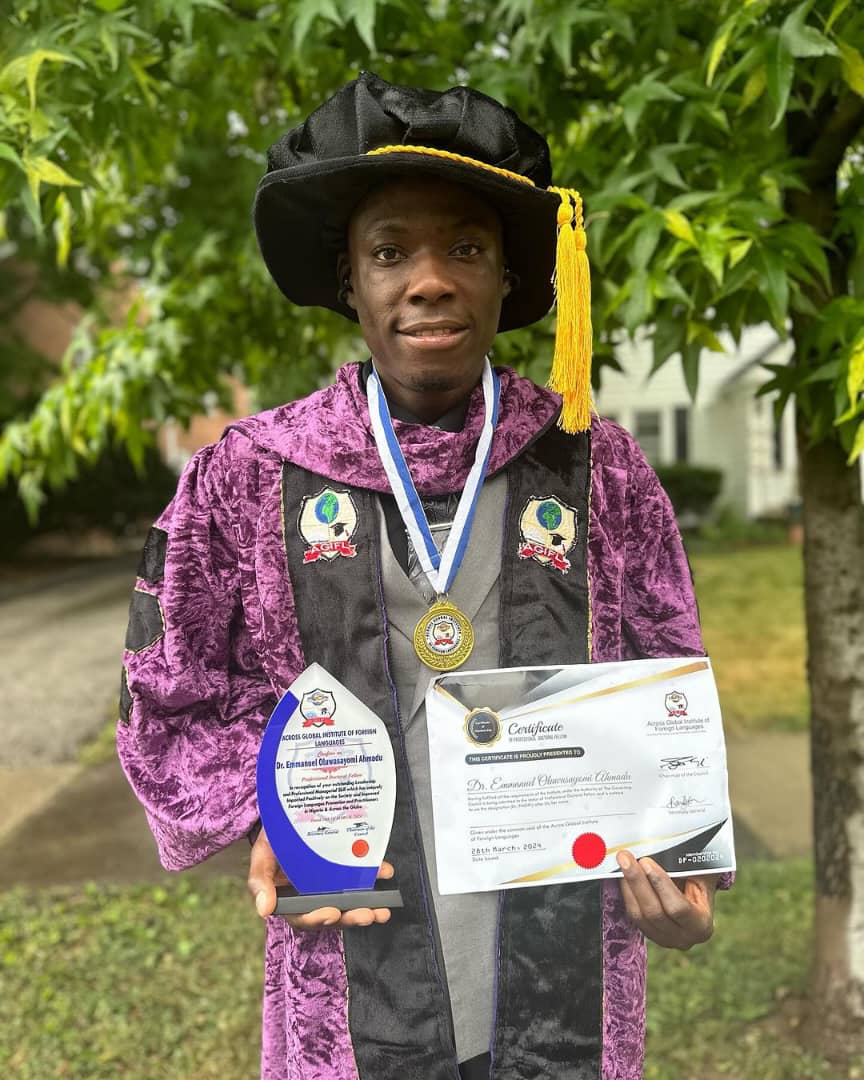
Dr Emmanuel Ahmadu, a Nigerian who wrote the West Africa School Senior Certificate Education, WASSCE, 17 times, has earned a distinction from the prestigious London Graduate School, UK.

Ahmadu, a Nigerian mental health advocate and accomplished professional based in the U.S., disclosed this in an interview with the News Agency of Nigeria, NAN, in Lagos.

He said that he was also inducted as a Fellow of the Institute of Management Consultants, FIMC, in Lagos. He said that the formal induction ceremony and certification workshop occurred in Lagos and UK on November 26, where he was lauded for his exceptional contributions.

He said his dual honour highlights his inspiring journey from writing ordinary-level examinations 17 times, due to family instability, to becoming a globally recognised figure in mental health advocacy and consultancy.

His new accolades would amplify his global impact, which would enable him to contribute to addressing mental health challenges, particularly among Gen Z, teenagers, and adolescents.

“My Fellowship, the highest grade of membership in the Institute of Management Consultants (IMC), will position me as a thought leader equipped to provide innovative strategies in tackling depression and suicide.

“This recognition is not just a personal milestone but a step forward in the global fight against mental health crises. It’s a call to action to innovate solutions that inspire hope and resilience.”

IMC, in its nomination statement, praised Ahmadu’s “outstanding academic and professional standing and demonstrated commitment to creating, maintaining, extending, and promoting the highest world standards of management consulting practice.”

Ahmadu said: “My certification as a Certified Management Consultant (CMC) will further enhance my credentials, making me to offer my expertise across over 50 countries, including the United States and the United Kingdom,” he added that his personal story had resonated globally, inspiring millions.

He said that Prof. David Iornem, Director-General of IMC Nigeria, during the induction, remarked that Ahmadu’s exemplified the transformative power of resilience.

Diamonds are forever!

0

Diamonds, a transparent and hard precious stone – have been known for use in producing pieces of jewellery among others. However, the latest scientific discovery has proven that they can also be deployed in producing valuable products.

The groundbreaking discovery by scientists from the United Kingdom (UK) Atomic Energy Authority (UKAEA) and the University of Bristol led to the creation of the diamond battery, considered the world’s longest-lasting battery.

A diamond battery is a type of battery that uses diamonds to convert nuclear energy into electrical energy. It works by using the radioactive decay of nuclear waste to generate electricity. The battery contains a small amount of nuclear waste, typically in the form of carbon-14. This waste is embedded in a diamond, which acts as a semiconductor. As the nuclear waste decays, it releases electrons, then collected and used to generate electricity.

Compared to normal batteries which merely last for a few months, the diamond battery is said to have the ability to last long as the half-life of carbon-14 is so long that it is said to last for about over 5,000 years.

Apart from its long-lasting source of energy, the diamond battery is also said to produce zero emissions or waste, making it a potentially cleaner source of energy. According to reports, another benefit of diamond batteries is being highly reliable as they require minimal maintenance.

The diamond battery is capable of producing low power levels by utilising the radioactive decay of carbon-14, which has a half-life of about 5,000 years. It works in the same way as solar panels, which generate electricity from light. Rapidly moving electrons from within the diamond structure are captured by the battery instead of light particles.

The prototype batteries are 10 mm by 10 mm and up to 0.5 mm thick, making them thinner than a sewing needle tip. Members of the team that built the world’s first diamond battery that can produce power for thousands of years include two female British Nigerians, Eseosa Ekanem and Fatimah Sanni, Senior Engineers at UKAEA.

According to ITV News, a British TV channel, Sanni said that they spent a couple of years trying to create a diamond battery. She explained that they were looking at having renewable energy sources to produce less waste and create a safer planet. “The diamond battery will revolutionise the battery industry.We are using carbon-14 which has a half-life of about 5,000 years that’s a long time,” Sanni added.

Ekanem said, “These batteries are made from diamonds that have been synthetically grown in the lab. “So, what we are trying to do is having the carbon-14 put into the diamonds, and diamond being a very hard substance, can absorb all the radiation and ensure that it doesn’t get out. And so, the actual battery itself is very safe.”

Journalists for Christ, World Association for Christ Communication, and others seek an end to gender-based violence in Nigeria

0

The Journalists For Christ (JFC) in collaboration with the World Association For Christ Communication (WACC) and other relevant stakeholders, on Thursday formally activated the #EndMisogynyNG advocacy campaign in Lagos, Nigeria.

The event held at the Sir Kensington Adebutu Media Resource Centre, Nigerian Institute of Journalism (NIJ), Lagos focused on trends and contexts of misogyny and tech facilitated gender-based violence (TFG-BV) in Nigeria.

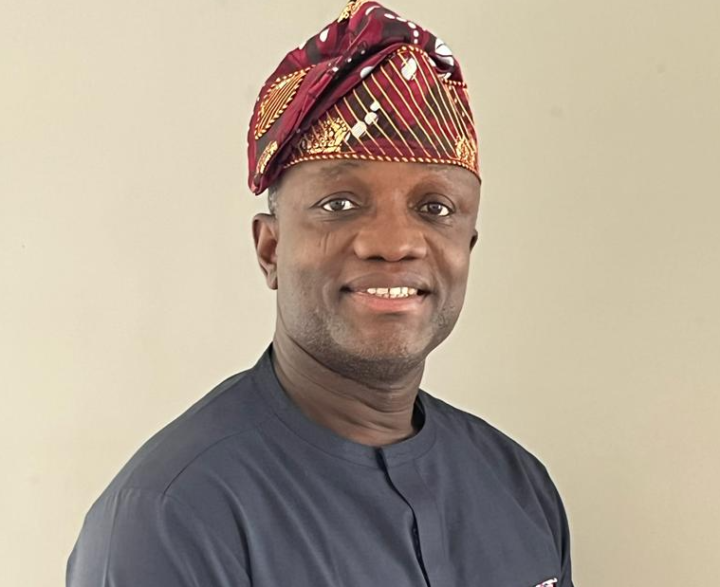
In the spirit of the #16DaysofActivism to end all forms of gender-based violence in society, the keynote speaker, Mr Femi Adesina, former special adviser on media and publicity to the past president, Muhammadu Buhari, urged participants to propagate the JFC report on misogyny.

Adesina said this would enable guilty perpetrators who are involved to stop all forms of antisocial and dehumanizing acts before they become an uncontrollable vice in society.

The provost of the Nigerian Institute of Journalism (NIJ), Mr Gbenga Adefaye applauded the advocacy initiative of JFC’s founding President and project coordinator, Mr Lekan Otufodunrin said it is a ‘’good thing and I would love to see and read this report because some of us may be an unconscious misogynist, acting unplanned or not being deliberate as agents who are mad at women.”

The Project Officer and Publisher of BoNews, Blessing Oladunjoye who spoke on the theme, “Understanding the Issues in Monitoring Social Media On the Trends of Misogyny and Tech-Facilitated Gender-Based Violence,” stressed how TFGBV is a form of GBV which is predominantly carried out online on digital spaces.

“This act usually targets women to harass them through electronic means or technological devices and is carried out via online channels or platforms,” she said.

She, however, mentioned various forms and categories of TFGBV that include cyberbullying, doxing, trolling, online sexual harassment and revenge porn while explaining the findings from the social media monitoring on the trends of Misogyny and TFGBV in Nigeria.

She said, “We discovered 49 cases of TFGBV on Facebook, 8 on X and Instagram, and 1 case on TikTok of a total of 66 cases found online.”

According to her, the percentage of male perpetrators of misogyny is 28.8% which comprises 19 posts, while female perpetrators comprise 25.8% of 17 posts, and Bloggers and Skit Makers with 22.7% of 15 posts and social media influencers/ public figures and other were 4.6% with 3 posts and some unascertained account holder with unclear identity to be 13.6% with 9 posts respectively.” Blessing emphasised.

She vividly gave examples of women who were victims of misogyny and TFGBV concerning how the announcement of Umeogi as the CEO of Zenith Bank sparked various misogynistic reactions online.

How 11 years old Sierra Leone girl survives three days at sea after a shipwreck

0

A rescue charity has narrated how an 11-year-old girl from Sierra Leone was rescued overnight after three days at sea as the sole survivor of a shipwreck off Italy’s Lampedusa island.

Germany’s CompassCollective said the crew on its vessel were en route to another emergency when they heard shouting from the water and picked up the girl around 3 a.m. wearing a life jacket and hanging on to a pair of tyre tubes.

Services, in every aspect, are in total collapse, in ruins. And who did that, the regime? It’s not the people. She told them she had set off from the Tunisian city of Sfax in a metal boat carrying 45 people that sank in a storm.

The charity crew took care of the girl and took her to Lampedusa, which is closer to North Africa than the rest of Italy and is often a first landing point for migrants.

REUTERS reported that after medical assistance, the girl was moved to a migrant holding centre where Italian Red Cross staff and volunteers were looking after her, the Red Cross said.

“In this festive period, in which the majority of us are lucky to be with our loved ones, my thoughts go out to the girl from Sierra Leone,” said Nicola Dell’Arciprete, head of U.N. children’s agency UNICEF in Italy.

“Yet another tragedy that increases the number of dead and missing in the Central Mediterranean.”

The sea migration route between Tunisia, Libya, Italy and Malta is one of the most dangerous in the world, with more than 24,300 disappeared or dying since 2014, according to the International Organization for Migration.

“Lives in danger at sea cannot be abandoned,” said Mediterranea’s Luca Casarini.

Italy says its hardline immigration policy is contributing to a fall in sea arrivals. In the year, it has recorded around 64,000 migrant landings, compared to more than 153,000 in the same period of 2023.

Home, ‘the abroad’ and reality!

0

Funso Aina

Whenever I am in Europe, or the US, and I see destitution, I always chuckle when I remember the millions of people back home, who are under the illusion that the streets in these ‘advanced countries’ are paved with gold of the 24-carat variety. Hollywood propaganda has not helped matters with the constant portrayal of the Western Hemisphere as paradise on earth. But that’s the essence of ‘soft power,’ I guess.

So yes, they have built functional systems, rather than what we have mostly in Africa where instead of strong institutions, we have ‘strong’ weak men, who pretend to lead us; men of straw who muscle everything through totalitarian, and oftentimes, pre-paid politics. Do not even let me start.

Bros, calm down and focus. Ok. The truth, my people, is that there are challenges in ‘the abroad’ too. For instance, despite the pervasive societal advancement, they also have homeless people – people sleeping rough, with only blankets shielding them from the elements, even during winter. And this includes both white and black people. A shade better than this category are those who live in camping tents.

I even saw a guy who was very creative about his dire living conditions. He used discarded carton boxes to demarcate his spaces. There were what looked like his ‘bedroom,’ ‘dining,’ and even ‘worship’ areas, adorned with pictures of Jesus (see pics).

Occasionally, you see people begging for money to feed, or as someone who should know told me, they spend the money mostly on cheap drugs and booze. But still, I saw someone so deprived that she wore shoes made from masking tape (see pic).

In Rome, I saw glimpses of the hard life some illegal immigrants live. By this, I am talking about the horde of Africans risking their lives and limbs, crossing the oceans in overcrowded boats – many of these people are living on the streets of ‘obodo oyinbo’ o (see pictures).

There’s a particular young man, who I am not sure is compos mentis. He camps out near the expansive Roma Termini train station, and he is always talking to himself, smoking and making balls of clay, which he spreads on the sidewalk. At other times, you will see him smashing up the balls, only to begin all over again.

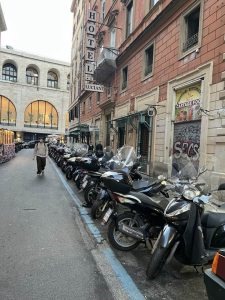
The other thing I noticed are elements of ‘Sapa.’ For instance, in dealing with rising energy costs, there’s a preponderance of very small, and mostly electric vehicles. In fact, many drive cars that are so small that it can accommodate only the driver (see pics). Many also make do with motor bikes and bicycles. But efficient public transportation system, like the underground trains/metro and buses are available and affordable. So many don’t even see the need to buy cars.

Why small vehicles are also attractive is because in most parts of Europe, parking space comes at a premium; most people park bumper to bumper on the streets. Infact, they park so close to each other that I wonder how they manage to extricate their vehicles anytime they want to go out. Nevertheless, they are still better off than people living in Japan are. In that country, before you buy a car, you must first prove to the authorities that you have a space to park it, otherwise, no car for you o.

Yet, these are some of the things we take for granted at home where people build large, fully detached houses with plenty of parking space. Not in ‘Italo’ in particular – in fact, the commonest mode of accommodation are massive blocks of flats, there are loads and loads of them. Spatial constraints make it difficult to find spaces to build detached homes. Perspectives.

NatWest Launches Growth Programme for UK Fintech startups

0

British bank NatWest is launching a programme to help scale fintech startups in the UK. The lender’s Fintech Growth Programme announced it was designed to give fledgling companies the resources, networks, and expertise of a large bank, hoping that participants will help bolster NatWest’s innovation efforts.

“This programme lays a pathway to create better outcomes for our customers,” David Grunwald, director of NatWest Innovation, said in a news release. “Working this closely with Fintechs and UK entrepreneurs strengthens our ability to be future-focused while supporting the growth of the innovation economy.”

NatWest plans to pick five Fintechs that offer solutions for specific problems in the payment sector, saying this is an ongoing issue in an increasingly digital world. Participating startups should be based in the U.K. and pre-Series A stage.

During 10 weeks of workshops, mentoring and coaching, NatWest will work with these Fintechs to “co-create solutions to lead the future of banking,” the release added. “The small cohort boasts opportunities to connect, learn and build networks with other fellow fintechs, coaches and NatWest’s dedication Innovation function.”

Writing about bank-Fintech partnerships earlier this year, PYMNTS argued these collaborations are becoming critical to “accelerating the adoption of open banking solutions and overcoming the challenges that financial institutions face in delivering horizon innovations to their end users.”

Although banks are typically established, trusted financial institutions, many are burdened with older systems and are slower to innovate. Fintechs, meanwhile, are nimbler, less burdened by regulatory oversight and able to test new solutions through trial and error.

“These bank-Fintech partnerships allow everyone to bring what they’re best at to the table,” Moa Agrell, senior banking relations manager at Trustly, told PYMNTS.

For banks, this means tapping into Fintechs’ ability to innovate and adapt. For Fintechs, collaborating with established banks lets them access industry knowledge, regulatory expertise and trust built over decades. These partnerships can ultimately drive progress.

“It can be a win for the bank, a win for merchants, a win for consumers and the industry overall,” Agrell said.